An evolutionary game approach to self-censorship
Feb 1, 2024··
0 min read
Qiankun Zhong
Abstract
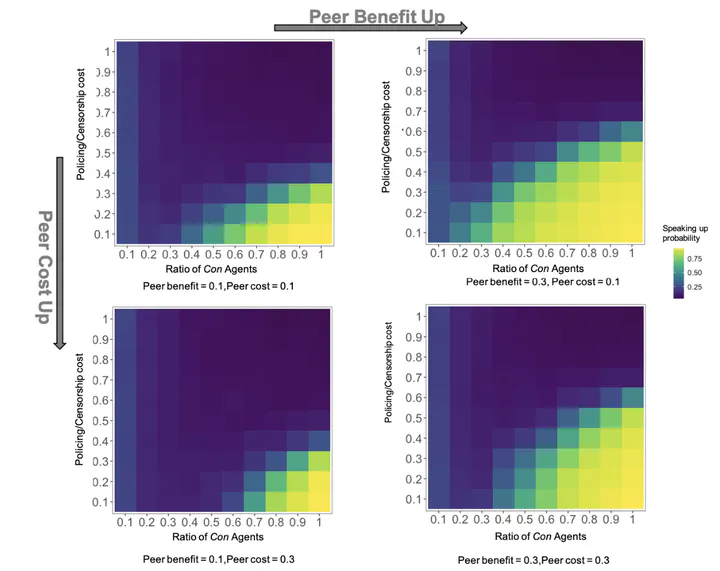
Self-censorship is the practice of withholding opinions or information from one’s audience, resulting in less posting and meaningful engagement in the public sphere. It can be helpful in politically charged environments when personal security is at risk. However, it also reduces the information flow of political discussion and limits the scope of civic engagement. One of the main reasons for self-censorship is people’s uncertainty about the potential risk of their statements or actions, including the risk of being censored by the government and being against socially approved norms. Social media increased users’ chances to learn information about censorship strength and the political environment, while social media platforms can also monitor and limit users’ access to politically sensitive information, increasing users’ uncertainty about the topic’s sensitivity, and leading to even higher levels of self-censorship. How can users reduce their uncertainty, as well as their self-censorship? This project aims to build an agent-based evolutionary game-theory model to investigate the process of how self-censorship emerges from uncertainty and search for possible solutions to reduce self-censorship.