The Role of Social Learning and Collective Norm Formation in Fostering Cooperation in LLM Multi-Agent Systems
Dec 1, 2025· ,,,·
1 min read
,,,·
1 min read
Prateek Gupta
Qiankun Zhong
Hiromu Yakura
Thomas Eisenmann
Iyad Rahwan
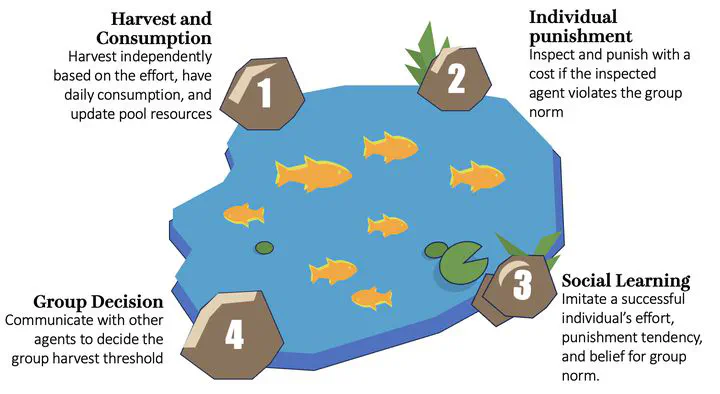 Image credit: Unsplash
Abstract
Governance of social-ecological systems is a major challenge in social science. Game-theory frameworks such as common-pool resources games (CPR) provide a useful tool to understand the different components of cooperation and governance of this complex issue. Now with artificial intelligence and Large Language Models (LLMs) increasingly been used in social systems and information infrastructures, can we apply what has been learned in the 30 years of CPR studies to evolve cooperation among LLM agents? We introduce a CPR simulation framework that removes explicit reward signals and embeds cultural-evolutionary mechanisms: social learning (adopting strategies and beliefs from successful peers) and costly punishment. Agents also individually learn from the consequences of harvesting, monitoring, and punishing via environmental feedback, enabling norms to emerge endogenously.
Type
Publication
The 25th International Conference on Autonomous Agents and Multiagent Systems
Click the Cite button above to demo the feature to enable visitors to import publication metadata into their reference management software.